



When you submit a claim to OneVerity™ Drone, what happens next is far more sophisticated than a simple web search. Under the hood, OneVerity™ runs a multi-layered, state-based verification process — one that doesn’t just look for an answer, but continuously evaluates the quality and consistency of that answer before delivering a result you can trust.
Here’s a look at the technology that powers every verification.
A Framework That Thinks in States
Most fact-checking tools process information in a straight line: input goes in, output comes out. OneVerity™ works differently.
At the core of OneVerity™ is a dynamically adaptive verification framework — a state-based engine that evolves throughout the verification process rather than following a fixed pipeline. Every submitted claim moves through a defined set of verification states:
| State | Description |
|---|---|
| Initial State | Claim received; verification begins |
| Partially Verified | Some evidence found; analysis continues |
| Inconsistency Detected | Conflicting signals identified; deeper review triggered |
| Escalation | High-complexity claim routed to additional verification layers |
| Verified | Final verdict reached with confidence |
This architecture means OneVerity™ doesn’t rush to a conclusion. If conflicting evidence is detected, the system escalates automatically — applying additional scrutiny before delivering a result.
Multimodal Input, One Unified Engine
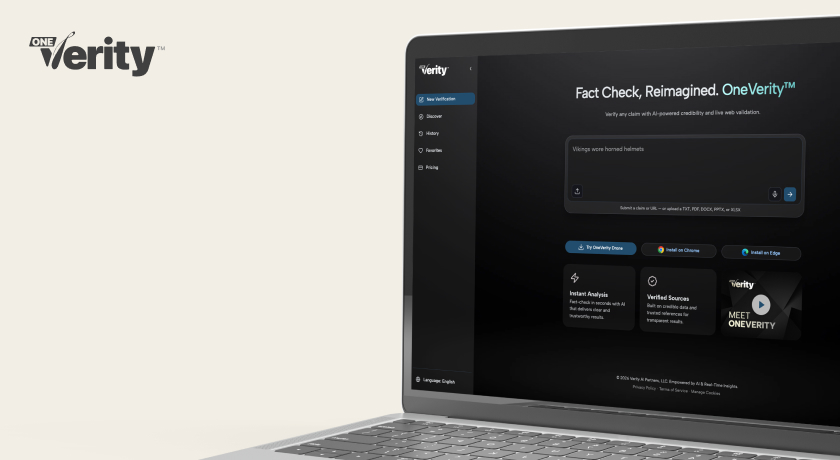
OneVerity™ Drone accepts verification requests across multiple input types:
- Screen captures from your desktop
- Uploaded files — PDF, Word, Excel, PowerPoint, and images
- Direct text or URL input
Regardless of how a claim arrives, it passes through the same Multimodal Input Module — a unified processing layer that normalizes each input type into a structured format the verification engine can analyze consistently and accurately.
This multimodal approach is central to OneVerity™’s accuracy. By combining signals from different input formats — text, document structure, visual context — the system builds a richer understanding of the claim than any single-modality approach could provide.
The Verification Engine: Six Core Components
Once a claim enters the system, six coordinated components work in concert:
- Multimodal Input Module — Receives and normalizes all input types into a unified data structure for downstream processing.
- Verification State Engine — Manages the lifecycle of each claim as it transitions through verification states, ensuring no result is finalized prematurely.
- Progressive Verification Controller — Determines how deeply to analyze a claim based on the complexity of evidence found at each stage.
- Cross-Modal Consistency Evaluator — Compares signals across different data sources and modalities to detect contradictions or gaps that may indicate misinformation.
- Adaptive Routing Module — Dynamically assigns verification tasks to the appropriate processing resources based on claim type, complexity, and available evidence.
- Distributed Execution Manager — Coordinates verification workloads across both user devices and remote servers, enabling efficient, scalable processing without compromising response time.
The Verity Score: How a Verdict Is Calculated
At the conclusion of every verification, OneVerity™ generates a Verity Score — a patent-registered truth scoring metric calculated from three key dimensions:
- Source Credibility — How reliable and authoritative are the sources supporting or refuting the claim?
- Information Recency — How current is the available evidence? Outdated sources are weighted accordingly.
- Semantic Relevance — How closely does the retrieved evidence actually relate to the specific claim being verified?
These three factors are combined into a single, interpretable score that drives the final True / False verdict — along with a full analysis summary, source list, limitations, and related verified facts.
AI Models Powering the Engine
OneVerity™ currently runs on a dual-model architecture:
- OpenAI GPT-4 serves as the primary engine — handling structured claim analysis, verdict generation, and deep reasoning across sources.
- Google Gemini 2.5 Flash operates as a fallback and supplementary layer — providing quick summaries, chat responses, and resilience when the primary model is unavailable.
This hybrid approach ensures that OneVerity™ remains fast, reliable, and accurate — even under variable conditions.
Looking ahead, Verity AI Partners is developing a custom proprietary verification engine through a phased roadmap: beginning with fine-tuned GPT-4 trained on OneVerity™’s own verified dataset, evolving into a Retrieval-Augmented Generation (RAG) system backed by a curated database of government and academic sources, and ultimately moving toward a fully self-hosted open-source model purpose-built for multilingual fact-checking at scale.
Distributed by Design
OneVerity™’s architecture is not confined to a single device or server. Its distributed execution model spans user devices and remote cloud infrastructure — allowing initial verification steps to run locally for speed, while more complex analysis is handled at the server level for depth and accuracy.
This design ensures that OneVerity™ remains responsive for everyday users while maintaining the computational power required for high-stakes, high-complexity verification.
Built to Evolve
The technology behind OneVerity™ is not static. The verification framework is designed to learn, adapt, and improve as more claims are processed, more sources are indexed, and more languages are supported. What you use today is the foundation of a system that will grow more accurate and more capable over time.
“We didn’t build a fact-checker. We built a verification intelligence platform.”
Experience the technology for yourself. Download OneVerity™ Drone today.
© 2026 Verity AI Partners, LLC. All rights reserved.